The emails, texts, and phone calls started just after 5:00 pm on Monday, January 19, 2026. Woodrow Place residents Bob Ward and Dana Sands had been taking an early evening walk along the towpath when they saw “what looked like at least 100 cubic feet per second of raw sewage flowing along the Clara Barton Parkway, then under the canal between locks 11 and 12, then into the Potomac.
It was like a big sluice. Water was flowing fast. We could hear it, and smell it, from the towpath.” They saw a police car and utility truck nearby, just observing. Bob and Dana alerted Mac Thornton of Wishbone Terrace, a founder of the Potomac Conservancy, who also served for 18 years on the Board of Potomac Riverkeeper Network.
Mac alerted his contacts there, as well as other neighbors, including CJCA co-presidents Scott and Heidi Lewis, and chair of Friends of Cabin John Creek Burr Gray. That same day DC Water posted a notice on their website stating they were “investigating a Sanitary Sewer Overflow from the Potomac Interceptor sewer line” and noted that “overflow is expected to reach the Potomac River.”
By 11:00 am on January 20, Mac was on camera with an NBC4 reporter on the scene describing the flow and making clear that a cause had to be established to help prevent future catastrophic overflows: https://tinyurl.com/art7w6wn.
Burr got out to the spill site that morning as well to get pictures of the situation, images that were then used by Dean Naujoks of Potomac Riverkeepers to get the attention of a WUSA9 reporter, who toured the spill area with Burr midday and posted a video story showing the full extent of the torrential flow of untreated waste water: https://tinyurl.com/37av52pw.
Over the next few days a phalanx of CJ-based and/or CJ-related people and organizations connected to the river, the canal, the people who live nearby, and the natural and historical resources therein, pitched in to document, report, and urge action from those responsible for repairing the sewer and mitigating the impact.
Citizens checked the site frequently to verify or dispute DC Water statements regarding the progress of efforts to redirect and limit the flow of sewage. Groups including Minnie’s Island Community Conservancy, the Sycamore Island Club, Cabin John Citizens Association, and Friends of Cabin John Creek, joined with the Potomac Conservancy and Potomac Riverkeepers Network to keep pressure on DC Water to stop the sewage overflow, request testing of the river and canal downstream of the spill, and monitor ongoing mitigation efforts.
Those efforts will continue into the future as the full effects of the release of hundreds of millions of gallons of sewage into the river and canal will not be fully understood for many months.
What Actually Happened?
On January 19, 2026, a section of the Potomac Interceptor (PI), a 72-inch sewer pipe owned and managed by DC Water, collapsed sending untreated wastewater above ground near the American Legion Bridge.
The effluent created a new “stream” just uphill from the C&O Canal, where it ultimately flowed into the canal and the Potomac River. Between January 19 and January 29, an estimated 300 million gallons of raw sewage spewed forth into our waterways at a rate of about 40-50 million gallons per day.
It is now one of the largest sewage spills in U.S. history.
The Potomac Interceptor was built in the 1960s and carries 60 million gallons of wastewater per day from Loudoun and Fairfax counties in Virginia, and Montgomery County, Maryland, to the Blue Plains treatment plant in Washington, D.C. The pipe has been under rehabilitation work since September 2025.
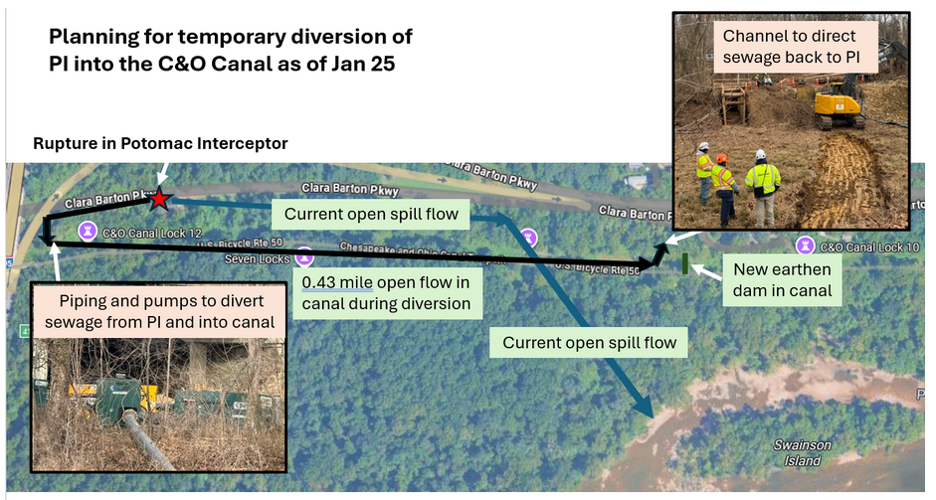
DC Water crews immediately mobilized after the collapse to set up a temporary bypass system, using industrial pumps to divert flow into the C&O Canal and back into the sewer system downstream of the break.
On January 23 DC Water began installing multiple high-powered industrial pumps, each capable of pumping seven million gallons a day, to divert the sewage into a section of the C&O Canal and then direct it back into the sewer line further downstream.
Six of the pumps were turned on January 24, with additional pumps added on January 26. By January 29 DC Water reported “no sewer overflows” from the broken pipe for the first time since the incident, although residual wastewater still needs to drain and repairs continue.
TIMELINE DC WATER EFFORTS DURING WEEK 1 POTOMAC INTERCEPTOR SEWER COLLAPSE
- Monday, January 19: Sewer overflow reported, Potomac Interceptor, Clara Barton Pkwy/I-495, Montgomery County
- Tuesday, January 20: Investigation, assessment, bypass plan developed
- Wednesday, January 21: Bypass piping install, canal debris/vegetation cleared
- Thursday, January 22: Upper lock gates removed from Locks 11, 12 and 13, pump installation begins
- Friday, January 23: Pump installation completed, downstream pipe reinforcement underway
- Saturday, January 24: Downstream reinforcement completed, bypass activated, most overflow contained
- Sunday, January 25: Bypass monitored, flow in downstream portions of the interceptor increases–40 million gallons a day, some overflow remains
- Monday, January 26: Additional pumps arrive, installation underway, some overflow continues
Repairs are expected to be complex and time-intensive, and so far there’s no firm timeline for full restoration. Researchers from the University of Maryland’s School of Public Health performed testing that revealed alarming contamination levels.
Fecal indicator bacteria, E. coli and enterococci, were 10,000 times over the recreational water quality limit according to Rachel Goldstein who leads the UMD team. Some fish kills have been observed downstream, and the Maryland Department of the Environment has already issued an emergency closure for shellfish harvesting 60-70 miles downstream as a precaution.
DC Water officials have consistently emphasized that drinking water supplies are not affected by the spill, but warn that contact with the river water, shoreline, or canal could pose health risks to people and pets. Naturally, there are concerns about long-term ecological effects on fish, wildlife, shellfish harvesting zones, and water quality, though research is ongoing.
Cabin Johners are reminded that Montgomery County health and environmental authorities have warned all should avoid touching the water or shorelines in impacted areas.
Resources to stay informed:
DC Water website: https://www.dcwater.com/
Potomac Conservancy website: https://potomac.org/blog/2026/1/30/potomac-interceptor-sewage-spill-updates
By Scott Lewis, Burr Gray, Joe Saliunas, Heidi Lewis