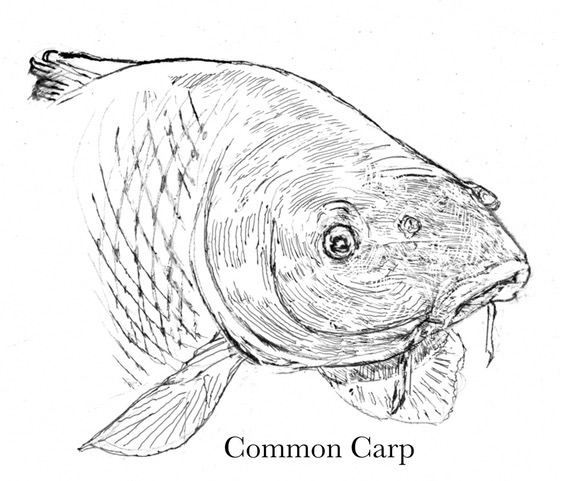
Summer strollers along the C&O Canal are often amazed to see schools of massive fish, lunkers as they are known to anglers, lurking in the dark water. They are common carp, an introduced species that is increasingly sought after by fly fishermen and reel casters alike.
In Germany, there are fishing clubs formed solely around the pursuit of this species of giant fish. The carp in the Potomac originally hail from the Caspian Sea region or East Asia and the species was probably introduced in the mid-1800s.
It remains unclear which species of fish they displaced or their overall ecological effects, as back then there were few fish biologists or aquatic ecologists trained to explore such impacts.
Today, we know that the common carp is the most widely introduced fish globally, found in almost every country. Local anglers pursue them for sport because of the fight they offer if they strike on light tackle; around the world, fish in the carp family are a main source of protein.
You won’t find carp on the menu much in the Potomac area, as they are too troublesome to filet, but in Asian cuisines, carp is a delicacy.
Our common carp grows to up to 30 inches in length and typically weighs about 10 pounds, but some can reach 30 pounds. They are distinguished by two barbels, or fleshy growths, on either side of the mouth, a thick body, an elongated dorsal fin, and a forked tail.
In the spring in the C&O Canal, when they are spawning, they make quite a splash, as several males can mingle with a single female as she lays more than 100,000 eggs over the aquatic vegetation.
There is no parental care; the baby carp are left to their own devices or blind luck to avoid a wide range of predators. Survivors reach maturity in three to four years and live about 15 years.
It is ironic that another common name of the carp family is the minnow family. Indeed, true minnows belong to this family, the Cyprinids, but so do some massive beasts. With over 3,000 species, the Cyprinidae is not only the largest family of freshwater fish in the world, it is also the most diverse family among all the world’s vertebrate families.
The largest Cyprinid is the Siamese carp, or giant barb, a species native to the Mekong River of Southeast Asia. The giant barb can reach 10 feet long and weigh up to 660 pounds, but overfishing has left it critically endangered.
Here in America, many people are familiar with another member of the Cyprinid family, koi, a popular fish of backyard ponds.
Along the canal, we can admire the fly fishermen trying to reel in giant carp. They stalk the spooky easily spooked fish and try to coax them into taking their lure, a tiny hook with a few strands of quills and feathers that can be made to resemble mulberry fruits or cottonwood seeds, two favorite food items when aquatic insects are not hatching in numbers.
We can admire even more the angler who tries to eat one of these fish. A common complaint about carp is that they are extremely bony. Unlike the easily fileted members of the salmon family, carp are full of tiny splinters that easily stick in your gums.
I will never forget my first time eating a fish in the carp family. It was the year 1975 and I was a newly minted Peace Corps volunteer with an unusual assignment to become a survey biologist in a newly created tiger reserve in the lowland jungles of remote western Nepal.
It took me two days and fifty miles on elephant-back to reach the headquarters of the Bardia tiger reserve. It was monsoon season, and all the roads were washed out, so the only way to reach the reserve was by elephant.
Soon after the elephant drivers dumped me off, the park warden suggested that we take a reconnaissance trip from the headquarters near our home village of Thakurdwara to the village of Chisapani (meaning “cold water”), located 16 miles north at the gorge where the mighty Karnali River leaves the outermost range of the Himalayas and reaches the Gangetic plain.
Chisapani was a small village populated by the Rajis, an ethnic group who lived by catching, among other fish, the giant Golden Mahseer, also one of the pre-eminent sport fish in the world for fly fishermen.
For many of the forest guards stationed at Chisapani, I was probably one of the first, if not the first, white person they had ever seen. Nepal had been closed to westerners until around 1960, but even in the ensuing 15 years, few westerners had ventured along the great Karnali.
In honor of my visit, the guards welcomed me with a feast: large chunks of freshly caught mahseer and piles of white rice, washed down with the unpleasant distilled rice wine known as raksi.
I had heard of mahseer, but I had no idea a large fish could have so many bones. After eating another mouthful of mahseer, which had quite a muddy taste, I swallowed. I felt something in my throat.
I tried to swallow again and took a swig of water. The object in my throat became more noticeable and then painful. It was a fish bone. For the next hour I tried everything that the Nepali guards told me to do when they had a similar problem: grab a big handful of rice and stuff it in my mouth, not to chew it, just swallow hard and force the fish bone down.
I tried that technique three times, to no avail. The fish had hooked me.
It was late by then, after ten and time for bed; I was exhausted after the 16-mile trek in the rain and concerned about the new resident in my throat. I lay down but had little luck in sleeping.
I must have dozed off a bit but when I woke up it was the same situation: the fish bone hadn’t budged. I started to contemplate my alternatives. The nearest doctor or clinic would be 65 miles away and take several days of walking in the monsoon rains to reach.
And the embarrassment! I hadn’t been at my post for two weeks and I would have to return to a health post or maybe even fly back to Kathmandu or take a bus to see a fishbone removal specialist.
Brooding over my rotten luck, I walked towards the surging Karnali River that was in full spate. The dark brown water hurtled along the riverbanks. I climbed up the carved wooden steps of a thatch-roofed platform that villagers used to watch over their rice paddies to keep the wild animals from eating their crops.
During the day, old men often sit on these platforms, play cards, and drink more raksi, especially during the monsoon, when, after the rice paddy is planted, there is not much to do but watch the river flow by.
I was trying to console myself when I saw an old man wearing nothing more than a Nepali hat called a topi and a loincloth. He climbed up the stairs and just stared at me. When I greeted him with a namaste, the traditional greeting (which literally means I bow to the god in you) words started to pour from his mouth.
I nodded because it was too painful to say more than a few words in Nepali, or any other language at the moment. He was telling me fascinating stories, one after the other: what it was like to live his whole life in Chisapani, fishing for the mahseer; the tigers that approached the village and sometimes killed their water buffalo.
Finally I had to stop him. I spoke up in Nepali, “Grandfather, I would love to hear your stories. But I have a fishbone stuck in my throat and it’s killing me.”
He merely smiled and said, “Why didn’t you say so? I will be right back.” He returned a few minutes later with a small leather pouch. He opened it and poured some dried and shriveled objects into his palm.
“Here, chew on these dried lali gurans petals. We fishermen get fish bones in our throats all the time. In a few minutes after sucking on the petals, the fishbone will pass.” And then he went off to tend to his buffalo.
An hour later, as if by magic, the fish bone was gone. I could swallow without pain. I had no idea what had just happened. Later, in grad school, I studied the chemical composition of lali gurans, the red rhododendron that is the national flower of Nepal.
I learned that the foliage of rhododendrons was quite toxic to herbivores, likely due to a compound called Andromeda toxin. Perhaps the dried petals concentrated minute amounts of Andromeda toxin that caused the mucous membranes in my throat to work overtime, coating the bone and dislodging it from my gullet.
Perhaps it served me as a placebo, and it was only a matter of time before the same membranes finally streamed the stuck bone away: a coincidence. In any event, I will never forget that lovely grandfather, his kind gesture, and his sparing me a miserable 65-mile walk in the monsoon rains.
I have never touched carp again. I still admire them as they splash about in spring in the canal, but I will leave them to the avid fishermen. Let them seize the day, and the fish.
Perhaps they have their own version of dried rhododendron petals if they choose to cook their catch.
By Eric Dinerstein, Contributing Writer
Illustration by Trudy Nicholson, Contributing Artist